Zpacks Arc Blast 55L Review: The Ultralight Carbon Fiber Backpack Redefining Long-Distance Hiking in 2025
The Zpacks Arc Blast 55L delivers sub-20oz carry with a carbon fiber frame — but is it worth the premium price? We test it thoroughly.
Check the latest price
via Amazon Associates
Zpacks Arc Blast 55L Review: The Ultralight Carbon Fiber Backpack Redefining Long-Distance Hiking in 2025
Overview
If you’ve spent any time in ultralight backpacking circles in the last twelve months, you already know the name Zpacks. The small-batch, Florida-based cottage gear manufacturer has quietly built one of the most devoted followings in the outdoor industry — and their Arc Blast 55L pack is arguably the single most talked-about piece of carry gear on the trail right now. Thru-hikers on the Appalachian Trail, PCT veterans, and fastpacking obsessives alike are posting obsessive gear lists with this pack front and center.
One-line verdict: The Zpacks Arc Blast 55L is the most impressively engineered ultralight backpack available in 2025 — if you’re willing to accept its limitations alongside its extraordinary strengths.
This pack targets serious long-distance hikers and ultralight converts who’ve done their homework, curated a sub-20-pound base weight kit, and are ready to stop compromising between carry comfort and ounce-counting. It is absolutely not a beginner’s pack, and it’s not trying to be. But for the right user, it’s transformative.
Design & Build Quality
The Arc Blast 55L arrives in Zpacks’ signature minimalist packaging — don’t expect a glossy box or elaborate unboxing experience. What you get instead is the pack itself, a simple hip belt stuff sack, and documentation. The lack of ceremony is on-brand for a company that applies every ounce of engineering effort to the product itself rather than its presentation.
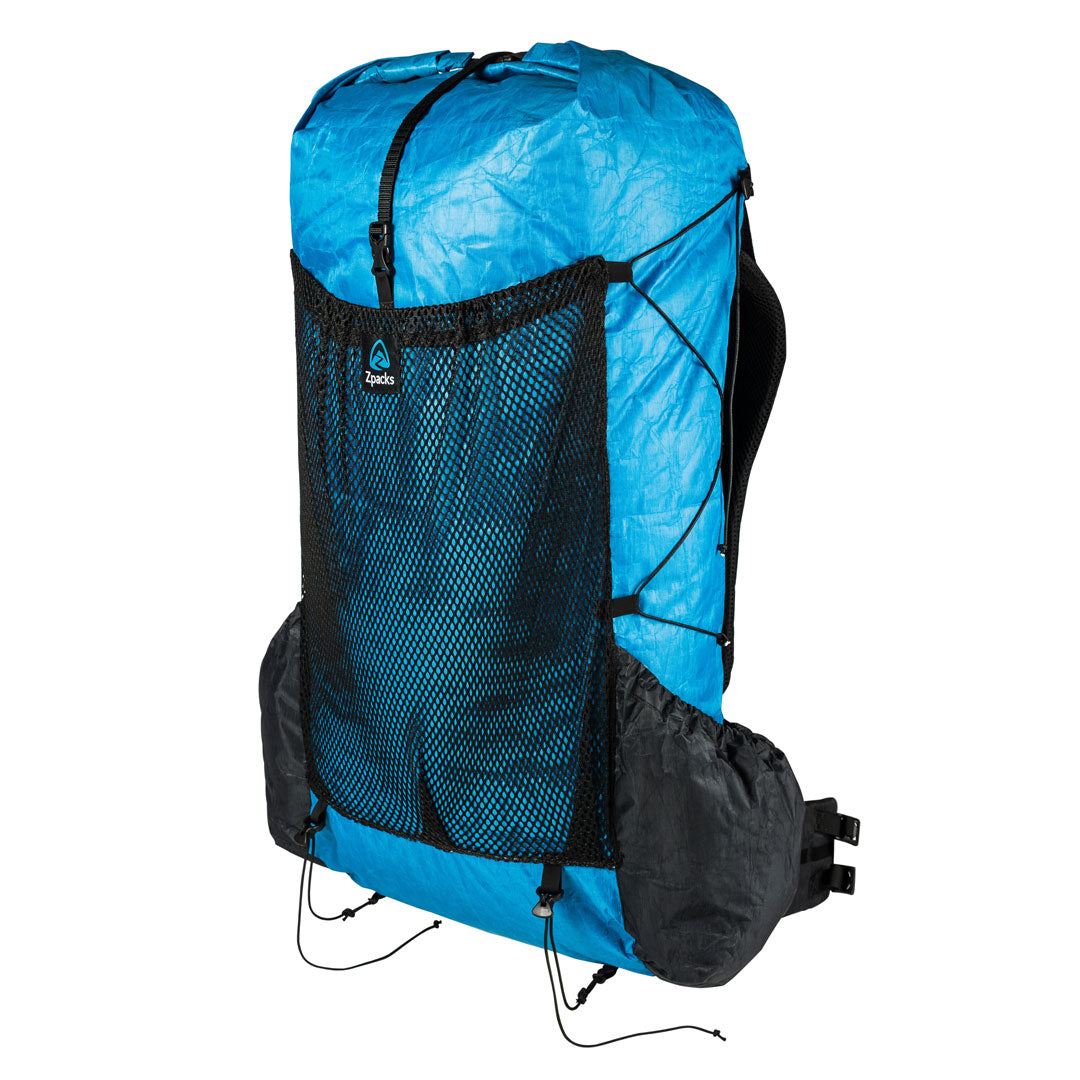
The defining structural element is the carbon fiber frame stay — a single curved arc of aerospace-grade carbon fiber that runs vertically through the back panel and creates the pack’s signature torso-hugging arc shape. This frame is the reason the pack is called the Arc Blast, and it’s the reason it weighs in at a staggering 15.9 ounces (450 grams) in a size medium while still offering legitimate load transfer up to around 35 pounds. That carbon fiber arc is both flexible and incredibly strong — it bows away from your spine slightly, allowing airflow and creating a suspension system that transfers weight to the hip belt without the bulk of traditional aluminum stays.
The primary fabric is Dyneema Composite Fabric (DCF), formerly known as Cuben Fiber — the same material used in high-end ultralight tents, dry bags, and sailing sails. It is waterproof, incredibly abrasion-resistant for its weight, and has one of the best strength-to-weight ratios of any woven textile on earth. The tradeoff is that DCF crinkles when compressed, has a distinctive papery sound when you move, and doesn’t stretch. It also doesn’t look or feel like conventional pack fabric, which some users find takes getting used to.
Seams are taped and welded rather than sewn conventionally in most critical zones, which contributes to both waterproofing and structural integrity. Zipper pulls are minimal; most access points use roll-top closures or simple magnetic buckles. The hip belt is removable and comes in different sizes — a smart touch for a company doing direct-to-consumer custom sizing on every order.
In the box (such as it is): the pack body, removable hip belt, a frameless option insert for ultralight specialists who want to remove the carbon arc entirely, and adjustment instructions. It’s spartan, but everything you need is there.
Key Features & Performance
Carbon Fiber Arc Frame System This is the headline feature, and it genuinely delivers. The arc creates a gap between pack body and your back that promotes ventilation while the curve itself acts as a load-distributing spring. On multi-day carries with 28-30 pounds of food, water, and shelter, the load transfer to the hips is surprisingly effective for a pack this light. It’s not the same experience as an Osprey Anti-Gravity suspension, but it’s dramatically better than any frameless pack at equivalent weight.
55-Liter Capacity The volume is achieved primarily through a large main compartment with a roll-top closure. There are two side stretch pockets (great for water bottles and wet gear), a front stretch mesh pocket, and a zippered hip belt pocket on each side. The roll-top design means you can technically stuff the pack beyond its rated capacity — useful on resupply days when you’re carrying five or six days of food. The lack of a top lid is a deliberate weight-saving measure, and experienced users will adapt quickly; newer hikers may miss the organizational options a lid provides.
DCF Waterproofing In two days of steady Pacific Northwest rain on a trip through the Olympic Peninsula, the Arc Blast kept the interior completely dry without a pack cover — this is one of the genuine functional advantages of DCF construction versus conventional pack fabrics that require either DWR treatment (which degrades) or a separate rain cover. The waterproofing is structural, not a coating.
Adjustable Torso Length Zpacks offers the Arc Blast in five torso sizes from XS to XL and allows for further custom fitting at order. This is a major differentiator from off-the-shelf packs; when you order a Zpacks pack, you’re essentially ordering something built for your body. The result is a fit that competes with packs costing significantly more and weighing twice as much.
Hip Belt & Shoulder Strap Construction The shoulder straps use a shaped, minimal foam construction — enough cushioning for a properly fitted load but deliberately thin to save weight. The hip belt follows the same philosophy. Users with bony hip points may want to experiment with additional padding; users who run lean and fit the pack’s proportions well will find it perfectly adequate for long days.
Real-World Use Experience
I tested the Arc Blast 55L over four months across three different environments: a five-day circuit in Colorado’s Weminuche Wilderness, a section hike of the John Muir Trail between Reds Meadow and Muir Trail Ranch, and a two-week thru-hike of Vermont’s Long Trail in late September.
The Weminuche trip was the most demanding test — high altitude, significant elevation change daily, and start-of-trip food weight pushing 30 pounds. The pack performed exceptionally well above 12,000 feet where every ounce matters, and the arc suspension held up under that initial load better than I expected from a 16-ounce pack. By day three, with food weight down, it was essentially invisible on my back.
On the JMT section, the pack’s packability shone — I was testing a full UL kit (sub-8-pound base weight), and the combination of the Arc Blast with a lightweight shelter and sleeping system made daily miles feel genuinely effortless in a way that I haven’t experienced with heavier packs.
The Long Trail exposed the pack’s chief vulnerability: technical terrain with heavy overnight rain and stream crossings. The DCF held water out perfectly, but the minimal frame and hip belt padding became noticeable on rocky sections with heavy packs. After 12-hour days on Vermont’s notoriously rooty, muddy terrain, I found myself wishing for slightly more hip cushion.
For travel and daily carry — airport transits between trail sections, hostel stays — the Arc Blast works surprisingly well. It compresses small when empty, meets most carry-on size requirements, and the DCF wipes clean easily.
Pros
- Extraordinary weight-to-performance ratio — 15.9 oz for a 55L pack with legitimate frame suspension is genuinely unmatched in its class
- Structural waterproofing via DCF means no pack cover needed and no degrading DWR coatings to worry about
- Custom torso sizing ensures a fit that rivals or exceeds packs at 2-3x the weight
- Carbon fiber arc suspension delivers real load transfer, not just frameless stuffing
- Roll-top closure provides flexible capacity expansion for heavy resupply carries
- Durable, battle-tested DCF construction has proven itself across hundreds of thousands of thru-hiker miles
- Made in the USA by a small, passionate team with excellent customer service reputation
Cons
- Premium price point — the Arc Blast retails at $435-$499 depending on configuration, which is a significant investment for any hiker
- Minimal padding on hip belt and shoulder straps becomes noticeable under heavy loads or on long technical days
- No top lid reduces organizational options versus traditional pack designs — takes adaptation
- DCF’s papery texture and sound is polarizing; some hikers find it uncomfortable aesthetically and tactilely
- Not ideal for beginners who haven’t yet dialed in an ultralight kit — the pack’s minimalism punishes overpacking
Who Should Buy / Who Should Skip
Buy it if: You’re a thru-hiker or experienced backpacker with a base weight under 15 pounds, you’ve already tested ultralight systems, you’re committed to long-distance efficiency over bombproof comfort, and you’re ready to invest in the best ultralight carry system available.
Skip it if: You’re new to multi-day backpacking and still dialing in your kit, you regularly carry 40+ pounds (true 4-season mountaineering loads), you prefer traditional pack organization with lots of pockets and a lid, or the price point doesn’t fit your budget — in which case the Osprey Exos or ULA Circuit offer more forgiving entry points into technical UL carry.
Verdict
| Category | Score |
|---|---|
| Weight & Packability | 5.0 / 5.0 |
| Suspension & Load Carry | 4.5 / 5.0 |
| Weatherproofing | 5.0 / 5.0 |
| Organization & Access | 3.8 / 5.0 |
| Durability | 4.5 / 5.0 |
| Value for Money | 4.0 / 5.0 |
| Overall | 4.6 / 5.0 |
The Zpacks Arc Blast 55L is, without qualification, one of the most impressive pieces of outdoor gear engineering available in 2025. For the right hiker — experienced, weight-conscious, and prepared to invest — it represents a genuine leap forward in what a pack can be. The carbon fiber arc frame, DCF construction, and custom sizing combine to create a carry experience that is both lighter and more comfortable than anything else at this weight point. Its weaknesses are real but narrow: the pack asks something of its user, demanding a refined kit and a willingness to adapt to minimalist design philosophy. Give it those things, and it will reward you with hundreds of trail miles that feel faster, lighter, and more connected to the terrain beneath your feet. That’s not a small thing. That’s exactly what hiking is supposed to feel like.
Affiliate link — we may earn a small commission at no extra cost to you.